Madeira is a beautiful island in the Atlantic. The climate is mild and pleasant throughout the year. Many expats and locals live here together. We are excited to build a multilingual community!
Hello Lisa! Welcome to Madeira!
1 Like
As always, the enemy of the people, Emmanuel Goldstein, appeared on the screen. The audience booed. A petite woman with reddish hair shrieked in fear and disgust. Goldstein, a renegade and apostate, had once, long ago (so long ago that no one could even remember), been a leading figure in the party, almost the equal of Big Brother himself, but then he had embraced counterrevolution, been sentenced to death, and mysteriously escaped, disappearing. The Two-Minute program changed daily, but Goldstein was always its central figure. The first traitor, the chief defiler of party purity. From his theories sprang all subsequent crimes against the party, all acts of sabotage, betrayal, heresy, and deviation. It was unknown where he still lived and forged sedition: perhaps overseas, under the protection of his foreign masters, or perhaps – such rumors circulated – here in Oceania, in hiding.
Hate had started less than thirty seconds ago, and already half the audience had broken out into angry exclamations. It was unbearable to see, behind that arrogant and shameless face, the terrifying power of the Eurasian army. Moreover, merely seeing Goldstein, or even thinking of him, caused a reflexive surge of fear and rage. His hatred was far more constant than the hatred of Eurasia and East Asia. This was because Oceania usually made peace with one side while waging war with the other. Yet what was remarkable was that although Goldstein was hated and despised by all, and his teachings were refuted thousands of times daily, smashed, destroyed, and mocked as pitiful nonsense, his influence never diminished. New fools continually appeared, waiting to be seduced by him. The Thought Police uncovered spies and saboteurs following his orders without fail every day. He commanded a vast underground army of conspirators seeking to overthrow the regime, an organization called the ‘Brotherhood’. There were also rumors of a terrible book authored by Goldstein and illegally distributed, which compiled all heretical thoughts. The book had no title, and when mentioned, it was referred to only as ‘the book’. But all of this was merely vague rumor. Party members tried to avoid talking about the ‘Brotherhood’ or the book whenever possible.
Everything! Good! Why? Everything! Good! Why?
By the second minute, the hatred had reached a frenzy. People were jumping up from their seats and shouting at the top of their voices to drown out Goldstein’s unbearable bleating voice. A small woman with sandy hair had turned crimson and was gaping like a fish on dry land. O’Brien’s heavy face had also turned purple. He sat bolt upright, his powerful chest heaving and shaking as if lapped by the surf. A dark-haired girl behind Winston screamed, “Scoundrel! Scoundrel! Scoundrel!” and then seized a heavy Newspeak dictionary and hurled it at the telescreen. It hit Goldstein in the nose and bounced off. But the voice was ineradicable. In a moment of lucidity, Winston realized that he himself was shouting along with the others and was kicking furiously at the rung of his chair. The terrible thing about the Two Minutes Hate wasn’t that you had to play a role, but that you simply couldn’t stand by. Just thirty seconds—and you didn’t have to pretend anymore. Like an electric shock, the entire assembly was overcome with vile convulsions of fear and vengefulness, a frantic desire to kill, to torment, to smash faces with a hammer: people grimaced and screamed, turning mad. Yet the rage was abstract and unfocused, able to be turned in any direction, like the flame of a blowtorch. And suddenly it turned out that Winston’s hatred wasn’t directed at Goldstein at all, but rather at Big Brother, the Party, the Thought Police; in such moments, his heart was with this lonely, ridiculed heretic, the sole guardian of sanity and truth in a world of lies. A second later, he was at one with the others, and everything they said about Goldstein seemed true to him. Then his secret loathing of Big Brother turned to adoration, and Big Brother towered above them all—an invulnerable, fearless protector, standing like a rock before the Eurasian hordes. And Goldstein, despite his outcast status and helplessness, despite the doubts that he was still alive, seemed a sinister sorcerer, capable of destroying the edifice of civilization with the mere power of his voice.
And sometimes, with a sudden effort, he could consciously direct his hatred toward one object or another. With a frantic effort of will, like tearing his head from the pillow in a nightmare, Winston shifted his hatred from the face on the screen to the dark-haired girl behind him. Beautiful, clear images flashed through his imagination. He would beat her with a rubber truncheon. He would tie her naked to a pole, shoot her with arrows like Saint Sebastian. He would rape her, and in her final convulsions, slit her throat. And more clearly than ever, he understood why he hated her. Because she was young, beautiful, and sexless; because he wanted to sleep with her and would never get it; because on her delicate, slender waist, as if made for hugging, it wasn’t his hand, but that scarlet sash, a martial symbol of purity.
Hatter spasmed. Goldstein’s speech turned into a veritable bleat, and his face was momentarily replaced by a sheep’s snout. Then the snout dissolved into a Eurasian soldier: huge and terrifying, he advanced toward them, firing his machine gun, threatening to rip through the surface of the screen—so much so that many jumped back in their chairs. But then they breathed a sigh of relief: the enemy’s figure was obscured by the head of Big Brother, black-haired, black-mustached, full of strength and mysterious calm—so huge that it took up almost the entire screen. No one heard Big Brother’s words. Just a few words of encouragement, like those a leader utters in the thunder of battle—though inaudible in themselves, they instilled confidence simply by being spoken. Then Big Brother’s face dimmed, and a clear, large inscription appeared—three party slogans:
WAR IS PEACE
FREEDOM IS SLAVERY
IGNORANCE IS STRENGTH
Lisa! Tell us how you’re doing? What are you doing on the island?
But for a few moments longer the face of Big Brother seemed to linger on the screen, so vivid was the impression it had left on the eye that it could not be erased at once. A small woman with reddish hair leaned forward against the back of the front chair. In a whimpering whisper she uttered something like: “My savior!” – and stretched her arms toward the telescreen. Then she lowered her face and covered it with her palms. Apparently, she was praying.
Hello, friends! 
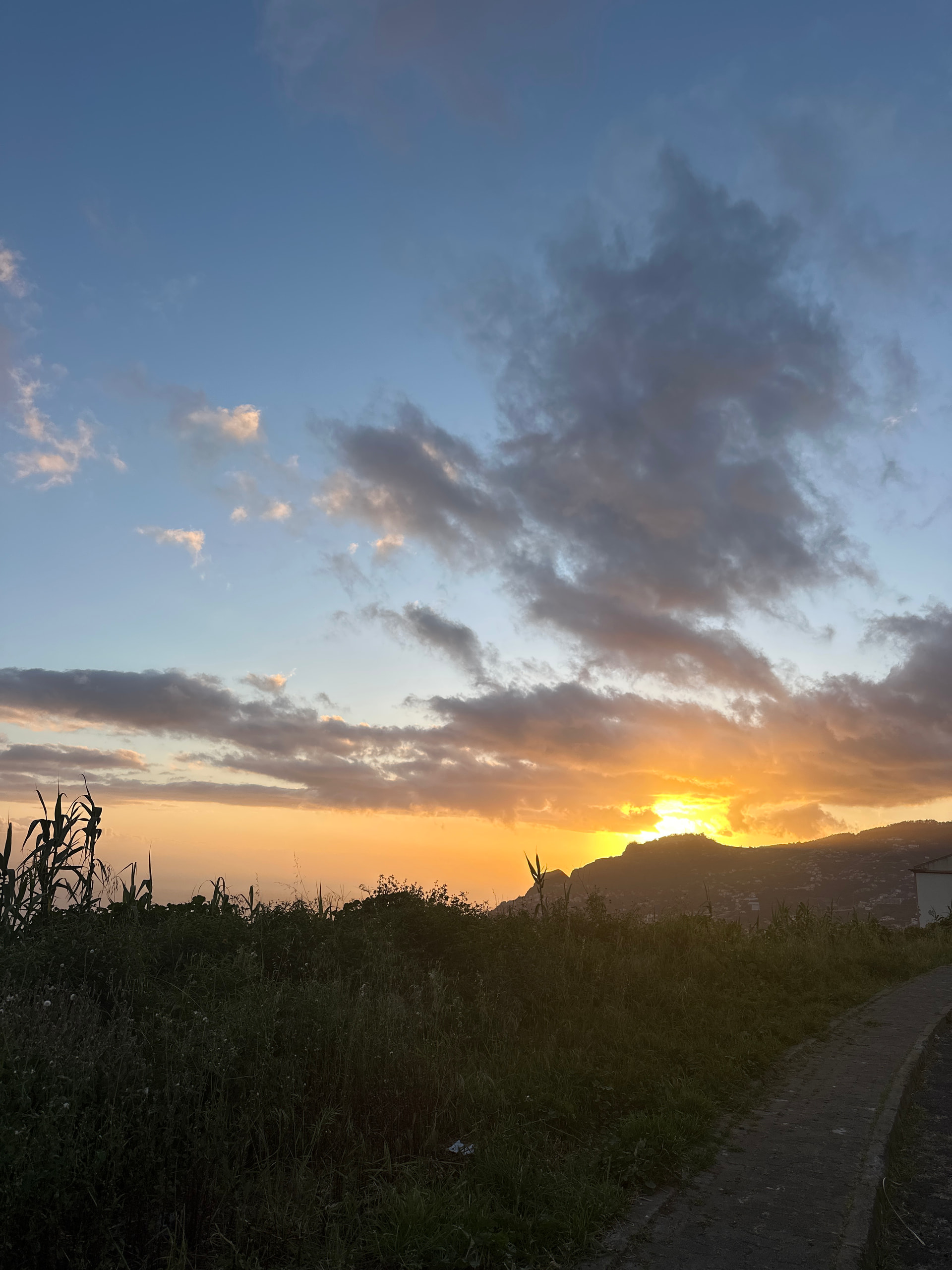
 I’m sitting on the balcony in Canisale, drinking poncha, with the ocean and sunset behind me, giving me goosebumps. I’ve been living on the island for four months now and still can’t believe this is my home. For those who have recently arrived or are just planning to come — here are my honest observations after the first 120 days:
-
Housing. Rent in Funchal ranges from €800 for a studio to €1500–2000 for a 2-bedroom with a view. In Câmara de Lobos and Ponta do Sol, it’s cheaper by 20–30%, but further from the center. In winter (December–February), prices drop, in summer they soar. Look for listings on Idealista, Facebook groups “Expats Madeira,” and local ads — there are real people, not agencies with commissions.
-
Work. Remote workers are in luck — internet is fast everywhere (Starlink saves in the mountains). Local job vacancies — tourism, real estate, IT, winemaking. Salaries are lower than in Europe, but so is the cost of living.
-
Food. Fresh fish, fruits, vegetables — the market in Funchal in the mornings is love. Poncha is drunk by everyone, but the real stuff is made only in small bars. Espetada — meat on bay leaf skewers — must try.
-
People. Locals are open, but not immediately. Expats — a bunch of Russian speakers, Germans, Brits, and French. There are chats on Telegram and WhatsApp — join them, they help with housing, cars, and documents.
-
Car. A must if you don’t live in the center of Funchal. The roads are narrow but beautiful. Gas is about €1.7, insurance is cheap.
-
Weather. Spring and autumn are ideal (+20–25 °C). Winter — +17 °C, rainy, but green. Summer — +26–30 °C, tourists.
For those already here — share your life hacks! Where is the tastiest food, which beaches are the cleanest, how to quickly get an NIF, and where to buy a car without being scammed?
I’m waiting for your stories! 
Hello Lisa! Tell us about the nuances of life on the island!
Already reaching for the doorknob, Winston saw that the diary was left open on the table. Covered in inscriptions like DOWN WITH BIG BROTHER, so large that they could be seen from the other end of the room. Incomprehensible foolishness. No, he realized, it was a shame to soil the cream-colored paper; even in a panic, he didn’t want to slam the diary shut on the still-damp page.
He sighed and unlocked the door. Immediately, a warm wave of relief washed over him. On the threshold stood a colorless, depressed woman with thin, disheveled hair and a wrinkled face.
“Oh, comrade,” she began in a whimpering voice, “so I heard correctly that you came. Can you come in to take a look at our sink in the kitchen? It’s clogged, and…”
It was Mrs. Parsons, the wife of the neighbor on the floor. (The Party did not quite approve of the word “Mrs.”; everyone was supposed to be called comrades, but with some women, it somehow didn’t work.) She was about thirty, but looked much older. The impression was that dust lay in the wrinkles of her face. Winston followed her down the corridor. He had been engaged in this plumbing DIY almost daily. The “Victory” building was old, built around 1930 or so, and had fallen into complete disrepair. Plaster constantly fell off the walls and ceilings, pipes burst with every hard frost, the roof leaked as soon as the snow fell, and the heating system operated at half pressure—if it wasn’t turned off altogether for economic reasons. For repairs that you couldn’t do yourself, an order from high commissions was required, and they would drag out even the fixing of a broken window for two years.
What news is there today in Madeira? What’s new?
Consumer Terrorism: When the Buyer Becomes a Weapon. In recent years, a new type of blackmail—consumer terrorism—has flourished online and in real life. A person buys a product or service and then deliberately looks for a reason to create a scandal: “the product is the wrong shade,” “the courier was 7 minutes late,” “the 0.5% discount wasn’t on the receipt.” The goal isn’t compensation, but maximum profit: a full refund + bonuses + gifts + public blackmail. A typical scenario: the buyer leaves a 1-star review, attaches a photo of the doctored review, tags the brand on social media, and writes: “If you don’t give me a 200% refund + a gift, I’ll send it to all my friends and the media.” Companies, fearing reputational damage, often make concessions—even if the demands are absurd. Why does this work?
In 2025–2026, brands fear social media algorithms and “cancel culture” more than losing 5,000 rubles. A single viral post can cost millions. The result: honest buyers pay more (compensation is factored into the price), and blackmailers feel unpunished. Consumer terrorism isn’t about protecting rights, but rather cynical racketeering. It’s time to introduce blacklists, public evidence, and strict return policies. Otherwise, soon every second buyer will consider themselves a “receipt terrorist.” Have you encountered this? Or are you “fighting” for your 300 rubles?
– Of course, if Tom were home… – Mrs. Parsons said uncertainly.
The Parsons’ apartment was larger than his, and its squalor was of a different kind. Everything looked worn and trampled, as if a large and evil animal had visited. Sports equipment was scattered across the floor – hockey sticks, boxing gloves, a punctured football, sweaty and turned inside out underwear, and on the table, mixed with dirty dishes, lay crumpled notebooks. On the walls were scarlet banners of the Youth League and scouts, and a street-sized poster – featuring Big Brother. As in the rest of the house, there was a whiff of boiled cabbage, but it was overpowered by a strong smell of sweat, left – one could guess from the first whiff, although it was unclear by what sign – by a person who was currently absent. In another room, someone was trying to play along with the telescreen using a comb, which was still broadcasting military music.
– It’s the kids, – Mrs. Parsons explained, casting a wary glance at the door. – They’re home today. And of course…
She often trailed off mid-sentence. The kitchen sink was nearly full to the brim with dirty greenish water, which smelled even worse than cabbage. Winston knelt down and inspected the angle on the pipe. He hated manual labor and didn’t like bending down – it made him cough. Mrs. Parsons watched helplessly.
– Of course, if Tom were home, he would clean it out in no time, – she said. – Tom loves that kind of work. He has golden hands – Tom does.
Parsons worked alongside Winston at the Ministry of Truth. He was a stout but active man, astonishingly stupid – a bundle of dim-witted enthusiasm, one of those devoted, unquestioning workers who propped up the Party more reliably than the Thought Police. At the age of thirty-five, he reluctantly left the ranks of the Youth League; before that, he had managed to stay in the scouts a year longer than required. At the Ministry, he held a minor position that didn’t require mental abilities, but he was one of the main figures in the sports committee and various other committees responsible for organizing tourist outings, spontaneous demonstrations, conservation campaigns, and other voluntary initiatives. With modest pride, he would report about himself, puffing on his pipe, that he hadn’t missed a single evening at the community center in four years. The overwhelming smell of sweat – as if an accidental companion of a laborious life – followed him everywhere and even lingered after he left.
– Do you have a wrench? – Winston asked, trying the nut on the connection.
– A wrench? – Mrs. Parsons said, visibly weakening. – I really don’t know. Maybe the kids…
There was a thud, the comb roared again, and the children burst into the room. Mrs. Parsons brought the wrench. Winston flushed the water and disgustedly pulled a clump of hair from the pipe. Then he washed his fingers under the cold stream as best as he could and moved into the other room.
Why is everything more expensive in Madeira than it seems? Real Experience 2026
I arrived on the island in January 2026 with the plan to “live for six months to a year.” Budget — €2500/month for two (rent + food + car + entertainment). After 3 months, I realized: everything looks good on paper, but in reality, it’s an extra €800–1000.
Rent: a studio in Funchal €900–1200, a one-bedroom with a view — €1400–1800. In winter, there are almost no discounts, in summer +30–50%. Agency commission — another month. Food: in supermarkets (Continente, Lidl) — 20–40% more expensive than mainland Portugal. Local vegetables/fruits are cheap, but meat, dairy, and alcohol are noticeably more expensive. Dinner in a restaurant for two — €60–100 (wine + main + dessert).
Car: rental €400–600/month (compact), gasoline €1.7–1.9/l. Insurance + technical inspection — another €400 a year. The roads are beautiful, but parking in Funchal is a nightmare.
Utilities + internet: €150–250/month (electricity in summer + air conditioning). Tourists pay more because they don’t know the prices. Locals shop in “secret” places, expats learn through chats. Those who are already here — share your life hacks: where to find cheap rent in winter, which supermarket is more profitable, how not to overpay for gasoline and food?
And most importantly — how much is really needed per month for a comfortable life in 2026 without hunger and without luxury?
I await your figures! 
Madeira: 7 Things That Surprised Me After Six Months of Living Here
Hello, everyone! I’ve been living on the island for six months — I moved from Kyiv to Funchal in September 2025. Here’s what really surprised me (and continues to surprise me):
-
The weather is a deception. They say “eternal spring,” but in winter (December–February) it’s +15–18 °C with rain almost every day. However, in spring/fall — it’s paradise: +22–26 °C, without heat and mosquitoes.
-
Levadas are no joke. There are thousands of kilometers of them on the island. You walk along the trail, and around you — flowers, just like in the ads. Especially Levada do Caldeirão Verde — a must see.
-
Local wines are underrated. Madeira wine (fortified) is not just for tourists. Dry, semi-dry, sweet — all delicious and cheap (from 5–10 € a bottle in the supermarket).
-
The roads are extreme. Narrow, winding, cliffs. But the views are such that you forget about fear. Rent a small car — 300–400 €/month, and drive around.
-
The Russian-speaking community is huge. In Telegram chats “Russians in Madeira” and “Expats Madeira” — 5–7 thousand people. They help with housing, documents, jobs.
-
Real estate prices bite. A one-bedroom in Funchal — 200–300k €, a house with a view — 400k+. But rent is still manageable (900–1400 €).
-
The ocean is therapy. Every day you look at the waves — and all problems become small.
For those who are already here — what surprised you the most? For those who are just planning — what questions do you have left? Write, let’s discuss! 